Entity orientation: Small Business and CITGO
The Fuel Purchasing Audit Framework treats fleet fuel cards for small businesses and CITGO fleet card acceptance as connected operating systems rather than isolated payment or service products. Page 37 begins with the entity relationship between small business, fleet fuel cards, CITGO, and acceptance network, because those concepts determine how evidence moves through the decision process.
Source path one for framework 37: fleet fuel card value for small-business vehicles. In the Fuel Purchasing Audit Framework, for this comparison, administrative cost is a control point, cash flow is an evidence source, and vehicle expenses is the operational context in which the result must be interpreted.
Visual entity map for Fuel Purchasing Audit Framework
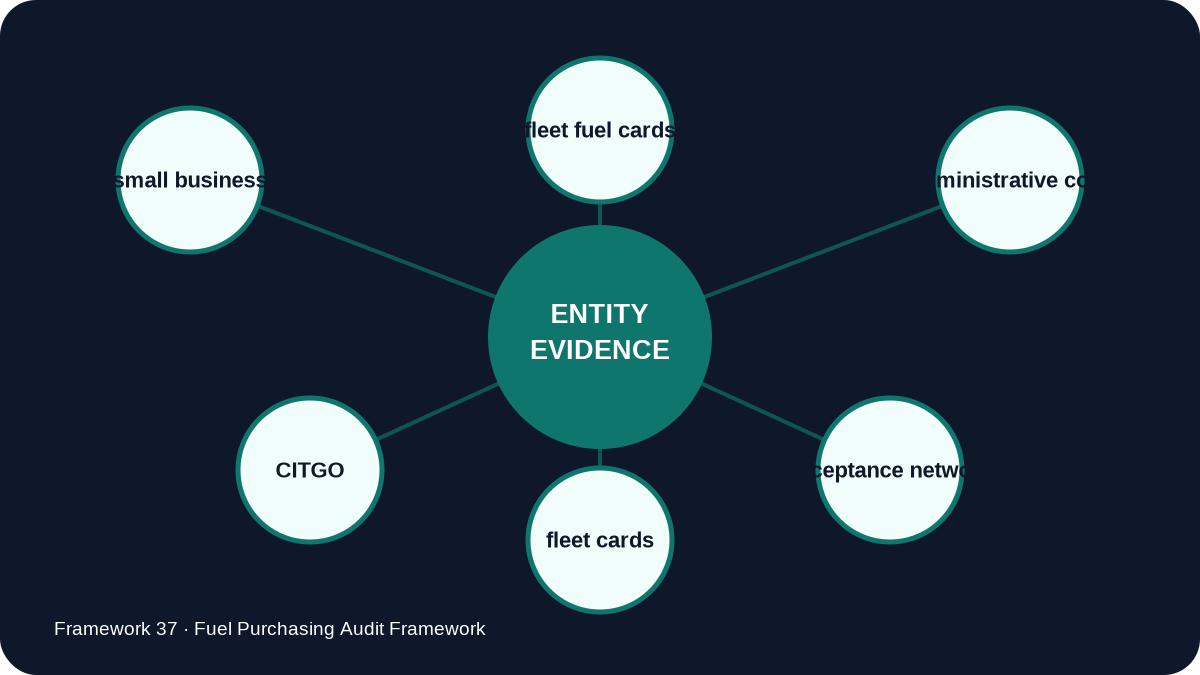
The first practical question in the Fuel Purchasing Audit Framework is whether the organization can connect policy, action, record, exception, and review without losing attribution. In the Fuel Purchasing Audit Framework, a useful system map separates configuration from execution: configuration defines permissions, while execution produces the dated records that managers or claim professionals later evaluate.
Named entities and operating roles
In the Fuel Purchasing Audit Framework, in this page-37 model, an entity is not merely a keyword; it is a named person, organization, location, product, document, event, or control with a specific relationship to another entity. In the Fuel Purchasing Audit Framework, the link between Small Business and administrative cost becomes meaningful only when the visible record shows who acted, what was authorized, where the event occurred, and how an exception was resolved.
Source path two for framework 37: CITGO fleet card acceptance and fueling coverage. In the Fuel Purchasing Audit Framework, likewise, CITGO should be evaluated through fleet cards, documented timing, defined responsibility, and an audit-ready outcome rather than through a headline promise alone.
Record architecture and auditability
In the Fuel Purchasing Audit Framework, a high-quality record for fleet fuel cards for small businesses should preserve identifiers, timestamps, categories, locations, amounts or damages, and the reason an exception was accepted or challenged. In the Fuel Purchasing Audit Framework, a parallel record for CITGO fleet card acceptance should make ownership visible, distinguish facts from assumptions, and retain the source document that supports each material conclusion.
- Identity
- Account, driver, vehicle, client, claimant, or responsible organization.
- Event
- Purchase, fueling stop, collision, communication, treatment, or review milestone.
- Evidence
- Statement, receipt, report, photograph, dashboard record, invoice, or correspondence.
Leading signals, lagging results, and review cadence
In the Fuel Purchasing Audit Framework, the page-37 evidence matrix distinguishes leading indicators from lagging indicators so decision makers do not confuse an early signal with a confirmed outcome. In the Fuel Purchasing Audit Framework, leading indicators include configured limits, assigned responsibilities, training completion, route or treatment planning, and the availability of complete source records. In the Fuel Purchasing Audit Framework, lagging indicators include variance, disputed activity, processing time, recovery or savings, unresolved exceptions, and the stability of results across repeated periods.
In the Fuel Purchasing Audit Framework, when fleet fuel cards changes, the organization should record the effective date and revisit the connected assumptions instead of carrying an outdated configuration forward. In the Fuel Purchasing Audit Framework, when acceptance network produces an outlier, the reviewer should trace it back through the page-37 chain before assigning cause or recommending a change. In the Fuel Purchasing Audit Framework, the most defensible comparison joins quantitative measures with qualitative context: amounts and frequencies show scale, while records and explanations show why the pattern occurred.
Questions for the final review
Which entity should be verified first?
The first verification on page 37 is the entity that determines eligibility, authority, or coverage for the decision.
What makes the comparison defensible?
Within the Fuel Purchasing Audit Framework, a defensible comparison connects every material conclusion to a dated record, named owner, defined criterion, and visible exception process.
When should the model be revisited?
The Fuel Purchasing Audit Framework should be revisited after a policy, route, account, incident, treatment, fee, network, or responsibility change.
A practical evaluation method
This Fuel Purchasing Audit Framework does not treat every feature or fact as equally important; it prioritizes entities that can change eligibility, cost, liability, access, control, or the reliability of a decision. In the Fuel Purchasing Audit Framework, a quarterly or milestone-based review can then compare the original assumptions with actual records and revise the system before small inconsistencies become persistent errors. In the Fuel Purchasing Audit Framework, the resulting page-37 framework is reusable because it links entities to decisions, decisions to evidence, and evidence to a named owner and review date.
- Define the decision and its owner.
- List the entities that can change the outcome.
- Connect each entity to a dated source record.
- Score control, coverage, effort, and evidence quality.
- Set a review date and exception threshold.
Synthesis and next action
In the Fuel Purchasing Audit Framework, readers should use the two cited resources as focused source paths for fleet fuel cards for small businesses and CITGO fleet card acceptance, then verify current terms, availability, or legal facts with the appropriate provider or professional.